ITAM and ITSM: The ultimate alliance to master your digital infrastructure

ITAM and ITSM Integration it has become the fundamental pillar for organizations seeking real operational efficiency. In a digital environment where hardware and software assets are the engine of the business, separating asset management (ITAM) from service management (ITSM) is a costly mistake that creates information silos and slows down incident resolution.
In summary: The integration of ITAM and ITSM allows support teams to have full visibility of assets in real time. This speeds up problem-solving, reduces unnecessary licensing expenses, and improves strategic decision-making.
What is ITAM and ITSM integration?
ITAM and ITSM Integration it is the process of connecting IT Asset Management processes with IT Service Management under a common database (usually a CMDB). While ITAM focuses on the life cycle and cost of assets, ITSM focuses on delivering value and user support. Their union ensures that each support ticket is linked to a specific physical or digital asset.
Key points
- 360° Visibility: Total control from acquisition to asset disposal.
- Accelerated resolution: Technicians gain instant access to technical data from the device.
- Cost savings: Identification of underutilized software or duplicate hardware.
- Cumplimiento legal: Gestión automatizada de licencias y auditorías.
- Enhanced security: Rapid identification of vulnerable or unauthorized assets.
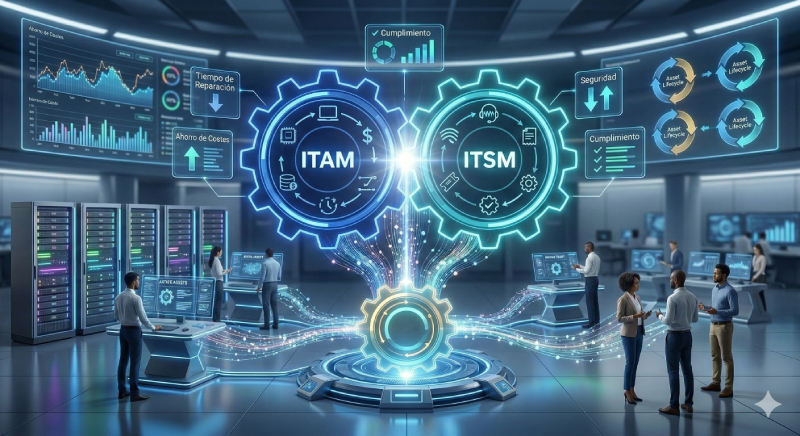
2 Key Benefits of ITAM and ITSM Integration by 2026
Implementing a unified strategy is not just a technical improvement, it's a competitive advantage. Here we detail the most impactful benefits:
1. Drastic reduction of Mean Time To Repair (MTTR)
When an employee reports a fault, the support technician often wastes time asking for the PC model or software version. With the ITAM and ITSM integration, the support ticket arrives with the entire technical data sheet of the asset automatically linked. This allows problems to be diagnosed in seconds, not hours.
2. Financial optimization and asset control
¿Sabías que muchas empresas pagan por licencias de software que nadie usa? The integration allows cross-referencing usage data (ITAM) with service requests (ITSM).
- It allows you to reassign existing licenses instead of buying new ones.
- It facilitates the planning of hardware upgrades based on real performance data.
Implementation strategy: How to unite both worlds?
For the integration of ITAM and ITSM to be successful, a centralized tool is necessary. According to Gartner, organizations that unify these processes reduce their operating costs by 15% annually.
Improved compliance and security
Licensing compliance is a constant financial risk. By integrating both systems, you can automate alerts when the number of installations exceeds the number of licenses purchased. Furthermore, in the event of a critical security patch, you will know exactly which users have the affected software and you can schedule a mass update task from the ITSM console.
Frequently Asked Questions (FAQ)
- What is the main difference between ITAM and ITSM?
ITSM se enfoca en el "cómo" se entregan los servicios y el soporte al usuario, mientras que ITAM se enfoca en el "qué" (los activos físicos y lógicos) y su valor financiero a lo largo del tiempo.
- Is it necessary to change software to achieve ITAM and ITSM integration?
Not necessarily. Many modern Service Desk platforms already include ITAM modules or allow API integrations with external inventory tools.
- How does this integration affect cybersecurity?
A lot. It allows the detection of "shadow IT" assets that are not registered and that can be entry points for attacks, linking them to immediate response protocols.
Conclusion
ITAM and ITSM Integration it is not optional in the era of digital transformation. By combining inventory with service, you transform your IT department from a cost center into an efficiency engine.
Are you ready to optimize your infrastructure? We can help you select the tool that best suits your needs. Contact us today for a demo!
Under the Hackers' Microscope: The Wave of Cyberattacks in 2026
Investment in Cybersecurity: The Financial Strategy Companies Can No Longer Ignore