Do you already have the tools you need? The Marketplace lets you know before you make any decisions
When an organization is evaluating or already using an ITSM/ITAM platform, the same question almost always comes up: "Will this work with what we already have in place?" RMM, external CMDBs, monitoring tools, CRM, cybersecurity platforms... a company's IT ecosystem is rarely built from scratch, and replacing tools that work just to "fit" with a new system is, in most cases, unnecessary.
That's where an integration marketplace comes in: it's not a feature you "need" to enable, but a place where you can check—before lifting a finger—which parts of your current stack are already ready to connect.
What exactly is an integration marketplace?
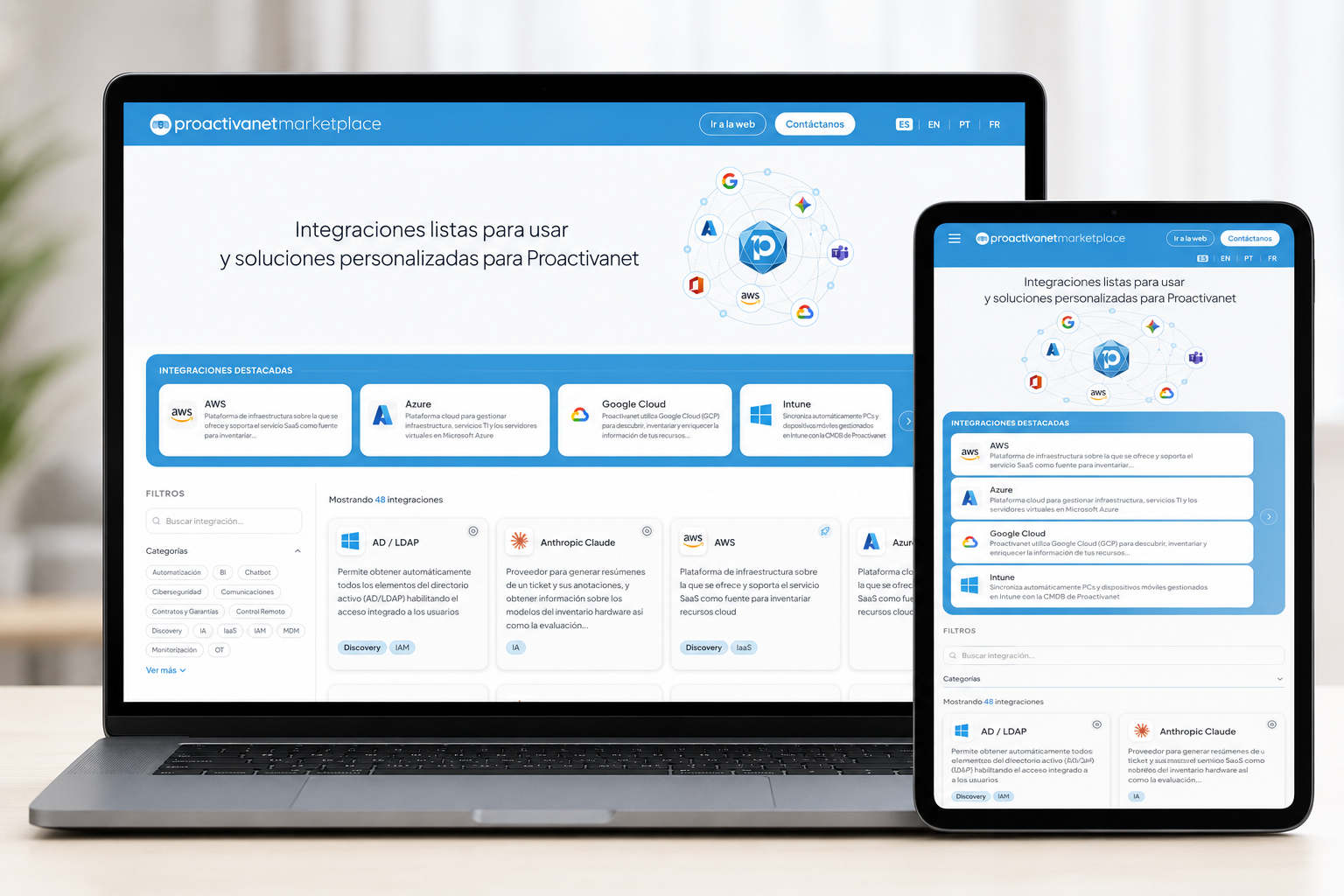
It is a centralized catalog that lists the connections already available between a platform—in this case, ITSM/ITAM—and other tools on the market: monitoring systems, RMM, CRMs, security tools, communication platforms, and many more.
Instead of relying on custom developments or ad-hoc integrations that take weeks to define, a marketplace offers:
- Instant visibility: You can search by tool name to see if an integration already exists.
- Reducing friction in the purchasing decision: If you're a lead evaluating vendors, the marketplace tells you in seconds whether you'll have to overhaul your processes or if everything will continue to work the same way.
- Building on what already works: For current customers, this confirms that the investment they’ve already made in other tools remains valid.
Who It's Really Useful For
If you're already a customer, the marketplace isn't just a catalog of "new things to buy": it's the fastest way to check whether that tool your operations, security, or support team already uses has a ready-to-use connector—without having to open a support ticket or wait for someone to confirm it.
If you’re evaluating a solution (you’re a lead in the comparison phase), the marketplace answers one of the most critical questions in any technology purchasing decision: Will I have to switch from tools that already work well for my team, or will this platform integrate with what I already have? Reviewing the available ecosystem of integrations before signing anything reduces perceived risk and speeds up the decision-making process.
In both cases, the underlying message is the same: it's not about replacing, it's about connecting.
How to Evaluate an Integrations Marketplace (No Matter Where It Is)
If you're evaluating different ITSM/ITAM platforms and each one has its own marketplace, you should consider the following:
- Actual coverage: not just how many integrations are listed, but whether they cover the categories you actually use (monitoring, security, communication, CRM...).
- Ease of activation: whether activating an integration requires custom development or if it is a guided process within the platform itself.
- Continuous updates: A static marketplace that doesn't incorporate new tools quickly loses value; what's important is that it grows alongside the market's actual technological ecosystem.
- Clear documentation: exactly what each integration does, what data it syncs, and how often.
The Proactivanet Marketplace: An Example of This Approach
At Proactivanet, we approach the Marketplace with this same philosophy: not as a showcase for additional features, but as a place where customers and leads can see at a glance which parts of their technology ecosystem are already ready to work together with the platform. The idea is simple: make your decision based on what you need to accomplish, not on whether you'll have to give up tools that already work for you.
Conclusion
A well-designed integration marketplace changes the underlying question. It's no longer "What do I need to change to adapt to this platform?", but rather "What do I already have that I can continue to use without any issues?" For IT teams that have already invested time and resources in building their tech stack, that difference is what determines whether a migration or a new implementation is perceived as a burden or as a natural improvement.
Suggested CTA: Explore the Proactivanet Marketplace and see in seconds if the tools you already use are ready to connect.

Under the Hackers' Microscope: The Wave of Cyberattacks in 2026

Investment in Cybersecurity: The Financial Strategy Companies Can No Longer Ignore