ITAM vs ITSM: differences, benefits and when a company needs each solution
ITAM vs ITSM: two acronyms that often appear in the same conversation but that IT managers are not always entirely clear about. Are they different disciplines? Do they compete with each other? Which one does your organization really need?
The short answer is that they are complementary, not alternatives. ITAM tells you what you have and how much it costs. ITSM defines how you manage it and how well you serve your users. When they work together, the result is an IT department with a level of control, efficiency and security that neither can achieve separately.
This article explains the 5 key differences between the two disciplines, when a company needs each solution and what it gains when it integrates the two into a single platform.
1. What is ITAM (IT Asset Management)?
ITAM, or IT asset management, is the discipline that deals with controlling the entire lifecycle of an organization's technology assets: from acquisition through deployment, maintenance, allocation and license management to decommissioning.
ITAM's core objective is to ensure that the organization knows exactly what assets it has, where they are, who is using them and how much they cost, in order to optimize spending, reduce risk and comply with regulatory requirements.
The areas covered by ITAM include the inventory of hardware such as computers, servers and network devices, the inventory of installed software and its versions, software licenses with their contracts and expirations, the life cycle of each asset from acquisition to retirement, the relationships between assets and their configuration through a CMDB, and the control of costs associated with the IT park.
📌 External reference: The ISO 19770 standard defines the international reference framework for software asset management, widely adopted as the basis for mature ITAM programs.
What is ITSM (IT Service Management)? ITSM, or IT service management, is the discipline that deals with how IT departments design, deliver, manage and continuously improve the technology services they provide to the organization and its users.
The core objective of ITSM is to make IT services work with the quality, availability and efficiency that the business needs, with well-defined processes to manage incidents, requests, changes and problems.
The areas covered by ITSM include incident management to resolve failures that affect users, request management to process service catalog requests, change management to control modifications in the IT environment, problem management to analyze root causes and avoid recurring incidents, the service catalog with the conditions for the provision of each service, the service desk as the central contact point between IT and users, and service level management or SLAs.
📌 External reference: The ITIL 4 framework is the de facto standard for IT service management, adopted by thousands of organizations worldwide.
3. ITAM vs. ITSM: the 5 key differences
Although both disciplines are part of the IT management ecosystem, their focus is clearly different. This table summarizes the 5 most relevant dimensions:
| Dimension | ITAM | ITSM |
|---|---|---|
| Management object | Assets: hardware, software, licenses | Services: incidents, changes, requests |
| Perspective | Control, cost, life cycle | Quality of service, user experience |
| Time horizon | Long term (asset life cycle) | Short and medium term (incident resolution) |
| Central question | What do we have and how much does it cost? | How do we provide IT services? |
| Main benefit | Cost optimization and compliance | Operational efficiency and user satisfaction |
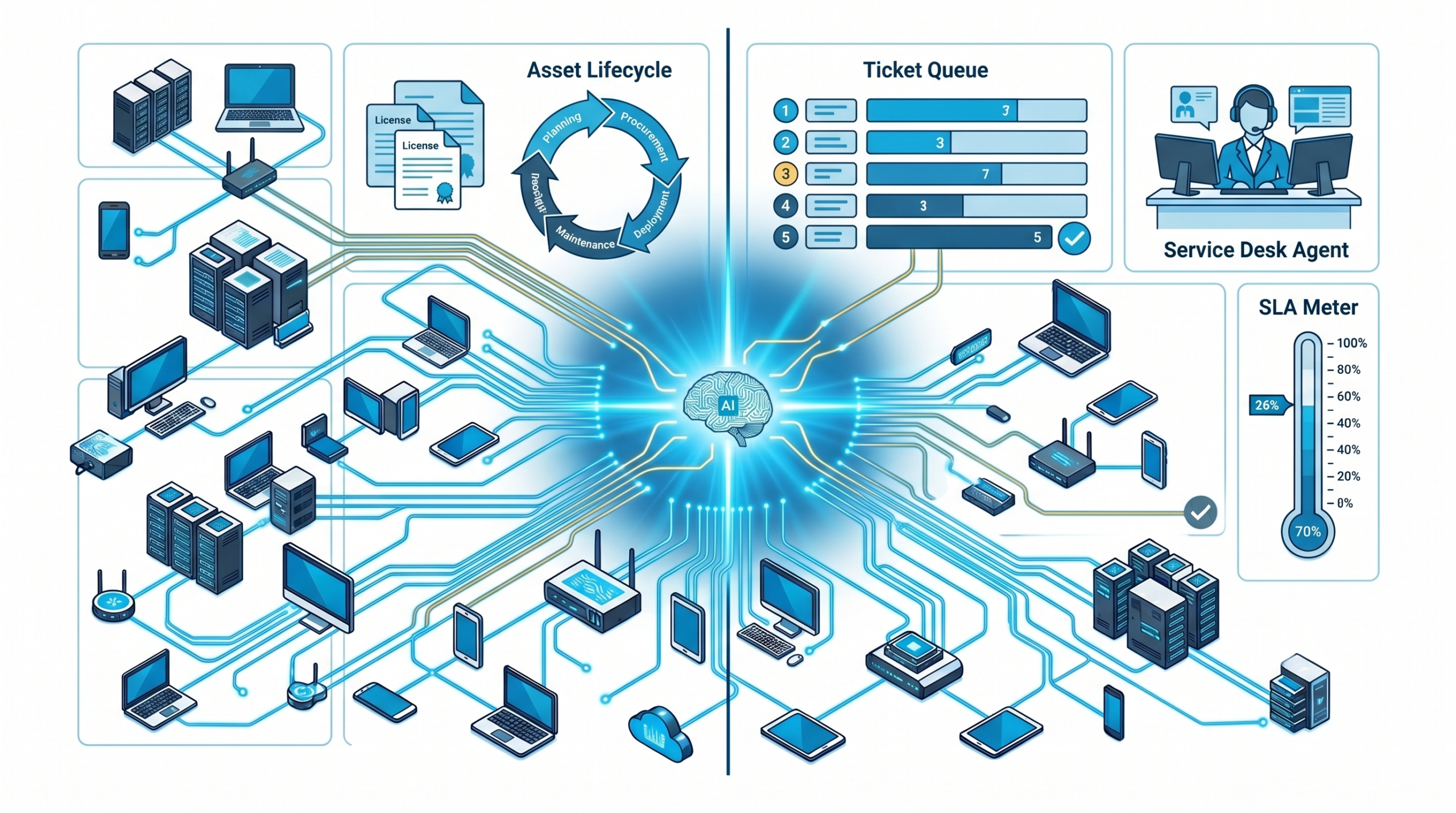
The table summarizes the conceptual differences, but in practice the two disciplines overlap and need each other. A change that does not take into account the assets involved is a change without control. An inventory that is not connected to the service desk is an inventory without context.
When does your company need ITAM?
There are clear signs that an organization needs to implement or improve its IT asset management program. IT inventory is managed in spreadsheets or is permanently outdated. There is no visibility into software licenses that are paid for versus those that are actually used. There have been problems in compliance audits due to lack of control over assets.
Also pointing to the need for ITAM is the fact that equipment is renewed without planning because no one knows when warranties expire, or that it is not possible to quickly identify which equipment has software with known vulnerabilities. In all these cases, the priority is to establish the reliable asset database on which to build everything else.
5. When does your company need ITSM?
The signs that point to the need for an IT service management solution are equally recognizable. Users do not have a centralized channel for reporting incidents or making requests. There is no record of tickets and no tracking of resolution times. Changes in the IT environment are made without control or documentation, which leads to subsequent incidents that are difficult to diagnose.
In addition, SLAs with the business are frequently breached with no data to explain why. The service desk works reactively, without defined processes. In this context, implementing ITSM makes it possible to establish the processes that turn IT operations into a measurable, manageable and improvable service.
6. When do you need integrated ITAM and ITSM?
Most organizations with a certain level of technology maturity need both disciplines working together. The signs that integration is necessary are clear: when an incident affects an asset, you don't immediately know what equipment it is, who is using it or what configuration it has. Changes are managed without knowing what assets are involved or what dependencies exist. The actual cost of resolving an incident cannot be calculated because it is not linked to the assets involved.
When ITAM and ITSM data are separated, each discipline works with incomplete information. When they are integrated, they feed back and the value of both is multiplied.
7. The biggest win: ITAM and ITSM in one platform
The real power of ITAM and ITSM is not in either separately, but in the synergy that occurs when they share platform and data.
Faster incidents with asset context. When a user reports a problem, the technician has instant access to the device's history: hardware, installed software, last update, previous incidents. This reduces diagnostic time significantly and eliminates ticket qualification questions that slow down resolution.
Changes with impact evaluated prior to implementation. When managing a change, the team can query which assets are affected, which services depend on them, and which users might be impacted. This minimizes failed changes and their consequences on service availability.
Stronger regulatory compliance. The combination of ITAM and ITSM makes it possible to demonstrate not only what assets exist, but also how incidents and changes that affect them are managed. This is especially relevant under NIS2, ISO 27001, DORA or the National Security Scheme.
Continuous optimization based on real data. The combined data allows you to identify which equipment generates the most incidents, which software causes the most problems or which changes have the highest error rate. This integrated vision is the basis for genuine continuous improvement.
8. What type of company benefits most from integrating ITAM and ITSM?
The straightforward answer is that any organization that relies on technology to operate benefits from this integration. But there are profiles for which the combination of IT asset management and IT service management is especially critical.
Companies with heterogeneous IT parks such as multiple sites or hardware and software diversity need the control provided by ITAM and the coordination provided by ITSM. Organizations in regulated sectors such as finance, healthcare, public administration or industry need the traceability that only the integration of both disciplines can provide. Resource-constrained IT departments need maximum efficiency with the equipment available, and that means automating both asset and service management. And growing companies need to scale their IT processes without proportionally increasing equipment, which is only feasible with an integrated platform.
Conclusion
ITAM vs ITSM is not a choice between two exclusive options: it is a false dichotomy. ITAM provides the map of the technology park; ITSM defines how services are provided over that park. When they work together, on a single platform with shared data, IT gains the control, efficiency and visibility the business needs.
Organizations that have integrated both disciplines not only operate better: they also respond faster to incidents, comply more easily with regulatory requirements and make much more informed technology investment decisions.
Want to see how integrated ITAM and ITSM work in practice? Request a demo of Proactivanet and discover the control you're missing out on.
IT Service Continuity Management: Preparing your business for the unexpected

IT Asset Discovery: The Essential Radar for your Infrastructure