Artificial Intelligence in ITAM and ITSM: how to automate IT asset and service management
Artificial intelligence ITAM is no longer a promise of the future but a real competitive advantage. Organizations already applying AI in their IT asset and service management report always up-to-date inventories, up to 60% shorter incident resolution times, and control over license spending that was previously impossible to achieve manually.
In this article you will find 7 concrete applications of artificial intelligence in ITAM and ITSM, with practical examples of how each one transforms the day-to-day life of the IT department.
1. Why is artificial intelligence a game changer for ITAM?
For years, IT teams have spent huge resources on repetitive tasks: manually updating inventories, sorting tickets, looking for dependencies between assets or reviewing the status of licenses before each audit. These tasks consume time, generate errors and keep the team busy with low-value work.
Artificial intelligence applied to ITAM and ITSM solves this problem at its root. It not only automates repetitive tasks, but turns every piece of data into actionable organizational intelligence. The specific benefits are:
- Reduction of manual work in data discovery, classification and maintenance.
- Faster response to incidents thanks to the automatic resolution of frequent cases.
- Decisions based on real data, not on estimates or outdated inventories.
- Continuous improvement of processes based on the learning derived from each interaction.
- License expense control by cross-referencing actual usage with active contracts.
📌 External reference: According to HDI's State of ITSM 2024 report, 67% of organizations that have implemented AI on their service desk report significant improvements in first-level resolution times.
2. Automatic asset discovery without manual intervention
Inventory is the foundation of any IT strategy. Without reliable data on what assets exist, where they are and what condition they are in, it is impossible to optimize costs, ensure security or plan correctly.
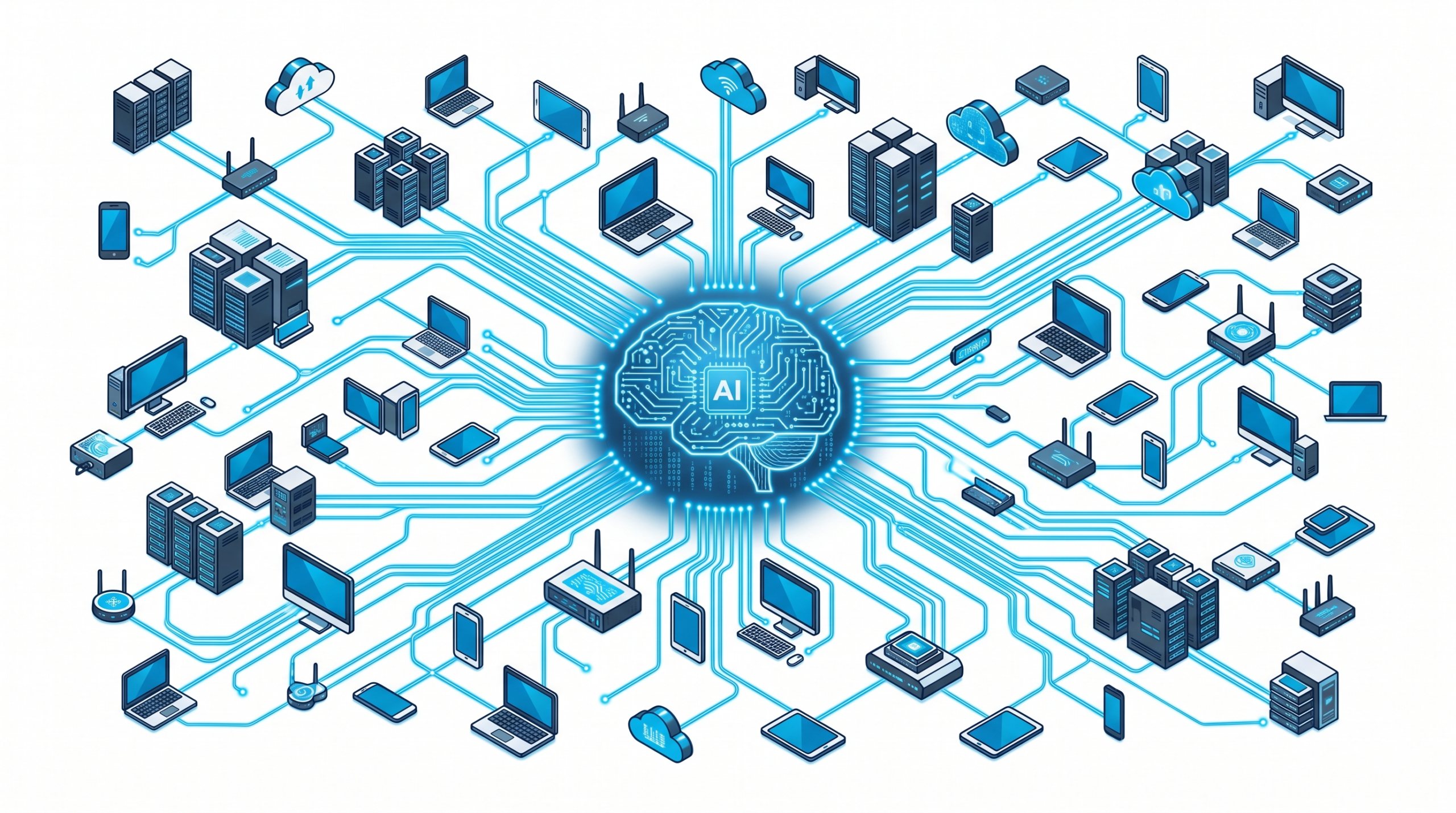
With IT asset management automation, intelligent agents continuously scan the network for connected hardware, software and devices without anyone having to launch a manual audit. The result is an inventory that is always up-to-date, free of transcription errors and available in real time.
The assets that an automatic discovery system detects include desktops and laptops, physical and virtual servers, network devices, printers, corporate mobile devices, virtual machines and containers.
3. Intelligent inventory classification and standardization
Discovering assets is only the first step. The second is to have that data organized in a useful way. AI models automatically identify and classify each asset according to its type, manufacturer, version and lifecycle status, eliminating duplicates and homogenizing information in a single reliable repository.
This standardization capability is especially valuable in organizations with heterogeneous IT fleets, where equipment from different manufacturers, generations and configurations coexist. Without AI, the process of cleaning and normalizing the inventory may require weeks of work. With AI, it happens in real time.
4. Predictive alerts on asset lifecycle.
AI analyzes the historical patterns of each asset to anticipate three types of critical events that IT teams need to know about in time to act:
- Hardware end-of-life: when a piece of equipment approaches the point where it costs more to maintain than to replace.
- Expiration of licenses and contracts: with enough time in advance to negotiate and plan for renewal.
- Risk of failure: components with anomalous behavior that statistically precede a technical failure.
This capability turns IT management from reactive to proactive, one of the most impactful changes in the department's operational efficiency.
5. IT support chatbot: 24/7 availability without increasing the team.
An AI-powered IT support chatbot is capable of handling frequent requests, guiding the user in resolving common issues and referring complex cases to the right technician, all without human intervention at the first level.
Among its most outstanding capabilities are the autonomous management of the first level of support for cases such as password reset, access management or basic software installation. It can also be integrated with the service catalog to handle agent-less requests, automatically log tickets with all relevant information from the first contact, and improve your resolution rate by continuously learning from each interaction.
The impact on service desk indicators is immediate: more cases resolved at first contact, shorter waiting times and human technicians freed up for the cases that really require their expertise.
6. Intelligent ticket routing and automatic resolution
AI in ITSM applies automatic classification algorithms that analyze the content of each incident or request and assign it to the correct resolution group right from the start. This eliminates unnecessary reassignments, reduces waiting times and improves the user experience.
For a high percentage of incidents - especially level 1 incidents - AI can execute predefined resolution flows without human intervention: restarting services, clearing caches, revoking or granting permissions, among other common cases.
7. AI-assisted root cause analysis
When several incidents point to a common origin, the AI identifies the pattern, groups related cases together and proposes corrective actions before the problem escalates. This capability transforms reactive management into proactive problem management, one of the most mature processes within the ITIL framework.
AI-assisted root cause analysis significantly reduces the number of recurring incidents, resulting in fewer interruptions for users and less burden on the support team.
8. Strategic decisions based on consolidated data
Beyond operational automation, artificial intelligence in ITAM and ITSM offers a strategic capability that is difficult to achieve by other means: converting the volume of data generated by the IT estate into actionable intelligence for decision making.
AI-enabled dashboards allow IT managers to identify trends in resource consumption or incident volume before they escalate, simulate technology refresh scenarios based on actual usage data, detect security anomalies or unusual network behavior in real time, and optimize asset allocation based on usage patterns by employee, department or site.
📌 External reference: The ITIL 4 framework incorporates data analytics and AI as key capabilities within the continuous service improvement practice.
9. What should an ITAM/ITSM platform with integrated AI include?
Not all solutions leverage artificial intelligence in the same way. When evaluating an IT asset management automation platform, it is important to verify that it incorporates these 6 key capabilities:
- Automatic discovery engine with continuous real-time inventory update.
- Native chatbot with self-learning capabilities and escalation to the human agent.
- Automatic ticket classification and first level resolution without human intervention.
- Predictive analytics applied to asset lifecycle and service behavior.
- Integration with the corporate ecosystem: active directory, ERP, deployment tools, etc.
- Intelligent alerts based on dynamic thresholds and historical behavior, not just static rules.
Conclusion
Artificial intelligence ITAM is not an option reserved for large corporations. It is a capability within the reach of any organization that wants to gain control over its IT estate, improve user experience and free its technical teams from low-value tasks.
Platforms that natively integrate AI can automate everything from asset discovery to incident resolution, license control and strategic decision making, all from a single solution. The result is an IT department that is more efficient, more secure and more aligned with business needs.
Want to see how AI can transform IT management in your organization? Request a demo of Proactivanet and discover all that is possible when inventory and support work alone.
You may also be interested in:
- IT inventory automation: how to reduce costs and improve security
- IT inventory software: guide to control assets, licenses and costs
- ITAM vs ITSM: differences, benefits and when a company needs each solution
Is Your IT Ready for 2026? How AI in ITSM Protects You from Data Breaches and Penalties
AI in ITSM: 8 Real Capabilities (and What's Just Marketing)