IT inventory automation: how to reduce costs and improve IT security
IT inventory automation is, today, one of the investments with the highest return within the technology function. Organizations that take the step of managing their IT estate automatically report average savings of 20-30% on software licenses, drastic reduction in time spent on administrative tasks and a substantial improvement in their security posture in the face of audits and threats.
If your IT department still manages inventory with spreadsheets or disconnected tools, this article describes exactly what you're losing and how the scenario changes when inventory works alone.
1. The real cost of a manually managed IT inventory.
Before talking about solutions, it is important to clearly dimension the problem. A manual inventory presents several sticking points with direct economic consequences that many organizations underestimate.
Unaccounted for assets, or phantom assets, are equipment in use that are not shown in the inventory, which prevents their management, updating or planned retirement. Paid but unused licenses are another common problem: without real visibility into usage, organizations renew contracts for software they may not need, or keep licenses assigned to employees who are no longer there.
Undetected vulnerabilities represent the most serious risk: outdated or unpatched software is an open door. Without reliable inventory, security teams cannot act quickly. And all of this is compounded by technician time spent updating spreadsheets and cross-referencing data between systems instead of working on higher-value tasks.
📌 External reference: According to Gartner, organizations waste on average 15% to 30% of their software budget due to lack of visibility into actual license usage.
2. What does it really mean to automate IT inventory
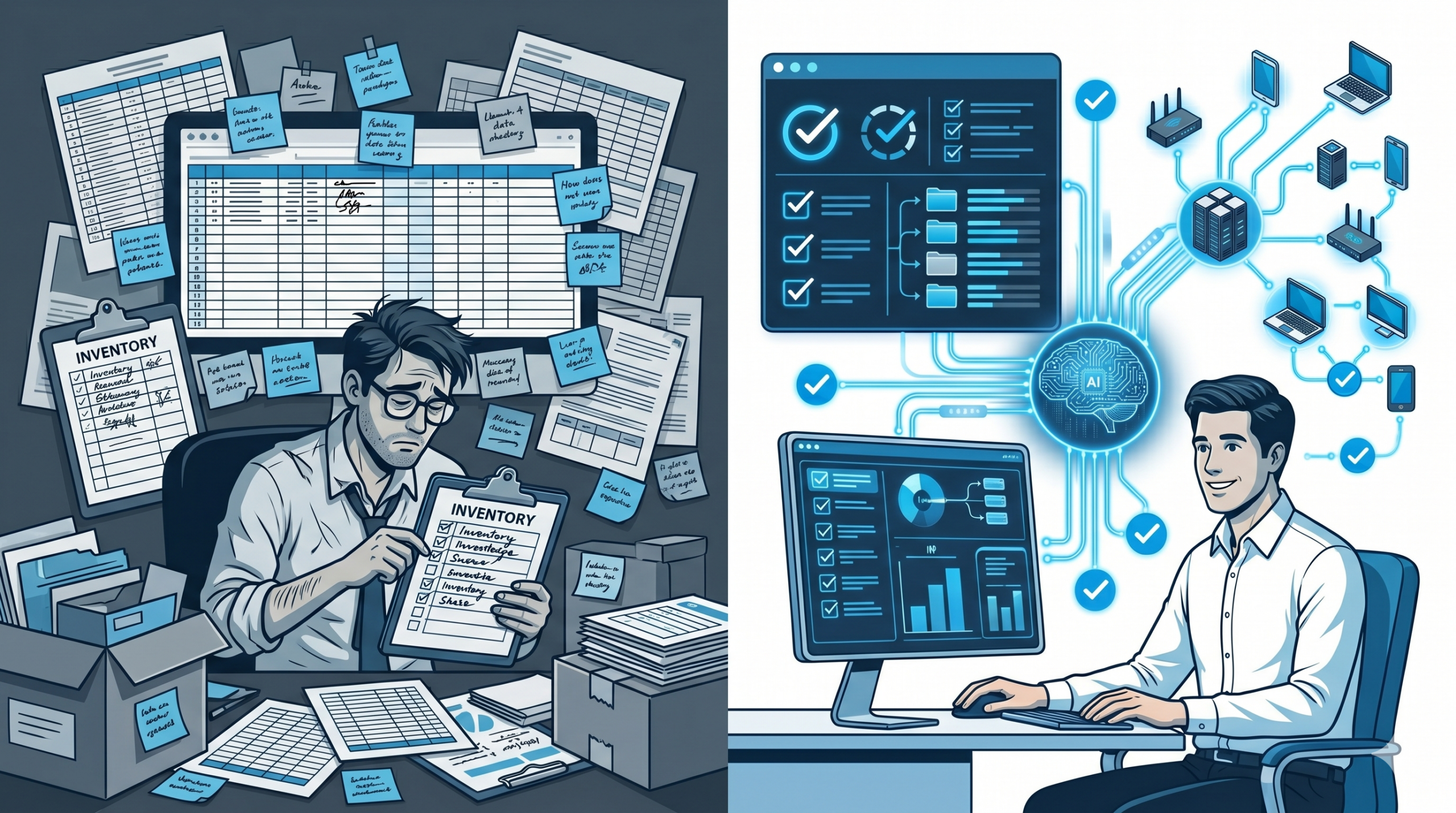
IT inventory automation involves delegating to the platform the tasks of discovery, logging, updating and alerting that previously required constant human intervention. It is not simply a matter of digitizing an Excel file, but of having a system that works autonomously to keep the inventory always true to reality.
The fundamental difference is that the inventory ceases to be a periodic snapshot of the IT park and becomes a live broadcast. Every change in the network, every software installation, every new or removed piece of equipment is reflected in real time, without anyone having to enter data manually.
3. Continuous hardware and software discovery
The core of automation is the discovery engine. Without the need for point audits, intelligent agents crawl the entire network to identify connected devices: computers, servers, printers, mobile devices, virtual machines and IoT equipment. Any addition or deletion is automatically reflected.
In terms of hardware and software inventory, the system also detects which applications are installed on each computer, which version is installed and whether they are up to date. This visibility makes it possible to act on known vulnerabilities in a matter of hours, not weeks.
4. License control to save IT costs
License control is the area where IT inventory automation generates the greatest direct economic impact. The system automatically cross-checks actual usage data with licensing contracts to detect two types of equally costly deviations.
Over-allocations occur when there are more installations than licenses purchased, which creates a risk of penalty in a manufacturer's audit. Sub-assignments, on the other hand, are the most common scenario: paid licenses that no one uses, automatically renewed year after year because no one had visibility on actual usage.
An automated system manages different licensing models (per device, per user, per subscription, per CPU) and triggers alerts in advance of renewal dates so that the IT team negotiates with data in hand, not blindly.
📌 External reference: The ISO 19770-1 standard defines the framework for software asset lifecycle management, including license control as a fundamental practice.
5. Proactive security: detecting vulnerabilities before they act.
Automated inventory is not just an administrative tool: it is an active layer of security. When the system knows exactly what software is installed on each computer and what version, it can cross-reference that information with databases of known vulnerabilities and alert the security team before a threat materializes.
If a computer installs new software, changes its configuration or connects from an unusual location, the system detects and notifies you. This capability is especially critical in regulated environments under regulations such as NIS2, ISO 27001, DORA or the National Security Scheme, where demonstrating control over the IT estate is a compliance requirement.
6. IT lifecycle planning and budgeting
With visibility into the health and lifecycle of each asset, the IT manager can do something that was previously very difficult: plan with real data. The system monitors the stage of each item and warns when the end of warranty, end of manufacturer's support or expected service life is approaching.
This makes it possible to plan renovations in advance, anticipate investments, justify budget items with concrete data instead of estimates, and avoid the situation of having to replace equipment in an emergency because it failed without prior notice.
7. Faster, safer onboarding and offboarding
Hardware and software inventory control has a direct impact on two critical moments in the employee cycle: onboarding and offboarding.
When an employee joins, the system automatically assigns the corresponding assets and records the assignment. When you leave, the inventory reflects the return or reallocation of equipment and licenses, ensuring that no access is left open in error and that released licenses are returned to the available pool. In environments with high turnover or remote work, this automation is especially valuable.
8. Hardware and software inventory: the integration that multiplies value.
It is a common mistake to manage hardware and software inventory as two separate realities. Both dimensions are interdependent and their integration multiplies the value of the information available.
One server can host ten critical applications. A user's computer may have unlicensed software. A virtual machine can run on hardware nearing end of life. Only by crossing both layers is it possible to have a complete and actionable picture of the IT estate, with relationships between assets automatically mapped in an integrated CMDB.
9. How to start IT inventory automation in 3 phases
The transition from manual to automated inventory does not have to be disruptive. In most cases, the process is structured in three well-defined phases:
- Phase 1 - Deployment of the discovery agent: installation on managed computers to start collecting data immediately. In many cases the first results are seen within hours.
- Phase 2 - Standardization and cleansing of the initial inventory: consolidation of existing information with newly discovered data, elimination of duplicates and establishment of the single repository of truth.
- Phase 3 - Configuration of alerts and automatic flows: definition of rules that will trigger notifications and actions according to the IT team's criteria: license expiration, end of warranty, unauthorized software, unknown devices on the network.
From then on, the inventory works autonomously and the IT team only intervenes when there are decisions to be made, not to keep the data up to date.
Conclusion
IT inventory automation transforms three key areas simultaneously: it reduces operational and licensing costs, strengthens the organization's security posture, and frees the IT team from low-value administrative work. The investment pays for itself quickly, and the benefits accrue over time as the system learns and improves.
The key is to choose a platform that integrates automatic discovery with lifecycle management, license control and security alerts in a single environment, without the need to patch different solutions.
How many IT assets do you really have under control? Request a demo of Proactivanet and get full visibility over your IT estate from day one.
