The forbidden alliance: Why the union of ITAM and FinOps is the secret to surviving 2026
In the traditional corporate environment, finance and technology departments have operated as silos. However, the recent report Deloitte Global ITAM Survey 2025 issues a disruptive warning: that separation is now the biggest financial risk. The convergence between FinOps and IT asset management has become the master pillar for companies aspiring to lead in the era of artificial intelligence.
In summary: The alliance between asset management and cost optimization in the cloud (FinOps) is the only effective defense against the complexity of AI. According to Deloitte, integrating these disciplines allows total visibility, eliminating the inefficiencies suffered by 82% of organizations that still maintain operational silos.
What is strategic IT asset management?
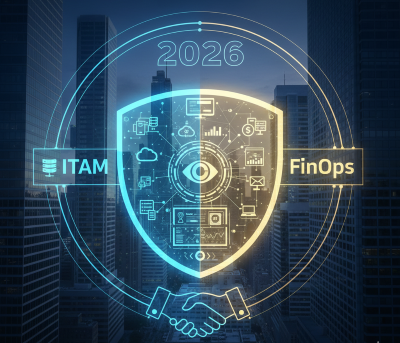
The IT asset management (ITAM) is the ability of an organization to transform technological inventory into competitive advantage. By merging with FinOps, it ceases to be a simple registry and becomes an intelligence unit that decides, in real time, where to invest each technological euro to obtain the maximum return.
Key points:
- Goodbye silos: IT-Finance collaboration is the critical KPI for 2026.
- 360° visibility: ITAM provides the licensing data; FinOps the cloud consumption.
- AI control: Essential for managing the variable costs of generative AI.
- Culture of responsibility: Each business unit takes ownership of its spending.
- Proactive optimization: Design savings before executing spending.
Why they call it "The Necessary Alliance" for 2026
The study reveals a troubling paradox: although 46% of leaders acknowledge that the link between IT asset IT asset management and FinOps and FinOps is the key to success, 82% admit that current 82% admit that the current synergy in their companies is low or mediocre..
This disconnection causes many companies to pay twice: once for the software license and once for the consumption of the same software in the cloud, without anyone crossing the data. In a world where Cloud and AI spending is the biggest cost center, this lack of communication is a financial hemorrhage that Deloitte urges to stop immediately.
Benefits of unifying IT asset management and FinOps
To move away from inefficiency, the report proposes a roadmap based on the integration of capabilities:
1. Establish a common data language
Finance talks about budgets; IT talks about instances and licenses. Successful companies are creating "centers of excellence" where both departments use a single source of truth: the company's data. IT asset management.
2. Real-time AI spending monitoring
AI consumes resources unpredictably. The ITAM-FinOps alliance makes it possible to set up automatic alerts that stop processes when the allocated budget is exceeded, something impossible if the teams are not synchronized.
3. Elimination of Shadow IT
When Finance detects a cloud expense that IT does not have registered as an asset, this alliance allows unauthorized software to be identified and regulated within days, reducing security risks and redundant costs.
4. Spending life cycle automation
78% of respondents plan to use intelligent automation. When an asset is no longer in use, the FinOps system should automatically stop the pay-as-you-go, closing the savings loop autonomously.
The impact on cyber resilience and compliance
A critical finding is that this alliance not only saves money, but protects the company. Only 29 % of the organizations formally include their IT asset management in the cybersecurity strategy. Joining forces with FinOps ensures that every paid asset is under the security radar, complying with regulations such as the EU AI Act or DORA.
Frequently Asked Questions
What is the difference between ITAM and FinOps? ITAM focuses on software and hardware license ownership and compliance. FinOps focuses on optimizing the value and variable spend of the cloud. Together, they offer a complete view of cost and technological value.
Why is it difficult to optimize IT asset management in AI? Due to the dynamic nature of AI models and their consumption based on tokens or computational power. Traditional inventory methods are not designed for assets that scale so volatile.
How does this alliance help sustainability (ESG)? By optimizing the use of resources and eliminating redundant assets, energy consumption and the digital carbon footprint are reduced, aligning technology with the organization's environmental objectives.
Optimize your digital future
The integration of IT asset management with FinOps is not a technical option, it is a business survival necessity. Deloitte's report is the definitive roadmap for its transformation.
Under the Hackers' Microscope: The Wave of Cyberattacks in 2026
Investment in Cybersecurity: The Financial Strategy Companies Can No Longer Ignore